The Power of Peer Collaboration
By TXCEE
Teachers know that students learn best when they are actively engaged in their own learning. The same applies to teacher professional development.
TxCEE’s Collaborative Language Acquisition Strategies for Success (CLASS) project is built on exactly this premise. Rather than positioning teachers as passive recipients of training, CLASS treats teachers as active contributors to one another’s growth, thus leveraging collective expertise through structured collaboration to drive meaningful instructional improvement.
How Peer Collaboration is Embedded in CLASS
The CLASS model is intentionally designed around Collaborative Learning Communities (CLCs), the central mechanism through which peer collaboration occurs. In these communities, teachers meet regularly to focus on instruction, student learning, and continuous improvement.
In these collaborative spaces, teachers work together to analyze student needs and progress, apply and test evidence-based instructional strategies, reflect on what works in real classroom settings, and refine their approaches over time.
This structure ensures that collaboration is not just frequent, but purposeful and directly tied to classroom practice. But does this collaborative approach really work?
What the Evidence Shows
The American Institutes for Research (AIR) has partnered with TxCEE to independently evaluate the CLASS program. Based on surveys, interviews, and focus groups with participating teachers, findings suggest that this collaborative approach is already yielding important benefits.
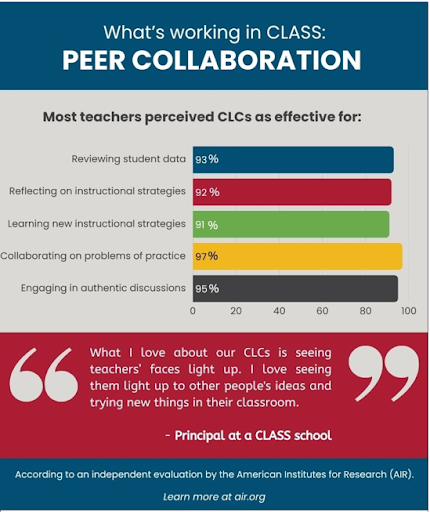
As shown in the infographic below, most teachers perceived CLCs as moderately or extremely effective for:
- Reviewing student data
- Reflecting on instructional strategies
- Learning new instructional strategies
- Collaborating with colleagues on problems of practice
- Engaging in authentic discussions with colleagues
In interviews, teachers and school leaders described CLCs as energizing spaces for shared learning and reflection. As a participating 4th grade teacher noted, “I think the CLC meetings are really, really enriching. I enjoy going in there and sharing what we know and also bouncing off each other’s strategies.” A school principal echoed this enthusiasm, explaining that what stands out most is seeing teachers light up as they engage with one another’s ideas and become open to trying new approaches in their classrooms.
Beyond Training: A Shift in Professional Learning
Ultimately, the success of peer collaboration in CLASS reflects a broader shift in how professional learning is conceptualized. Rather than relying on external expertise alone, the project recognizes that teachers themselves are powerful learning resources.
By centering collaboration, CLASS transforms professional development into an ongoing, interactive process where teachers learn from each other’s experiences and continuously improve through shared reflection.
This approach not only strengthens instruction in the short term but also builds lasting capacity within schools. As the CLASS project continues, it offers a compelling example of the power of collaboration to foster professional growth and strengthen instructional practice.